
You Got What You Asked For

On choice, shame, and the contract nobody told you about.
The broken toy
Imagine a child who asks Santa for a toy. Commits to that one thing, writes it on the list, believes in it completely. Christmas morning comes and the toy is there — but it's broken. Not a little broken. Irreparably, visibly, permanently broken.
And now every other kid on the street is outside showing off what they got. Shiny, working, impressive things. And this child is standing there holding something that doesn't do what it was supposed to do. Will never do what it was supposed to do.
And people start to whisper. Maybe the child did something. Maybe the child isn't worthy of better. Maybe we shouldn't waste our time on someone who has nothing to bring to the table.
That child is me. That toy is my children. And I am not going to apologize for saying that out loud.
The fine print under any choice.
We live in a moment where a woman's right to choose is loudly, fiercely defended — until she chooses to have children. Then the conversation shifts fast. Children are expensive. Children are inconvenient. And if you chose them anyway, everything that follows is yours to carry alone. The sleepless nights. The financial hemorrhage. The isolation. You chose this. Don't make your choices someone else's problem.
To a point, I understand that logic. Parenthood is sacrifice. That was always the deal.
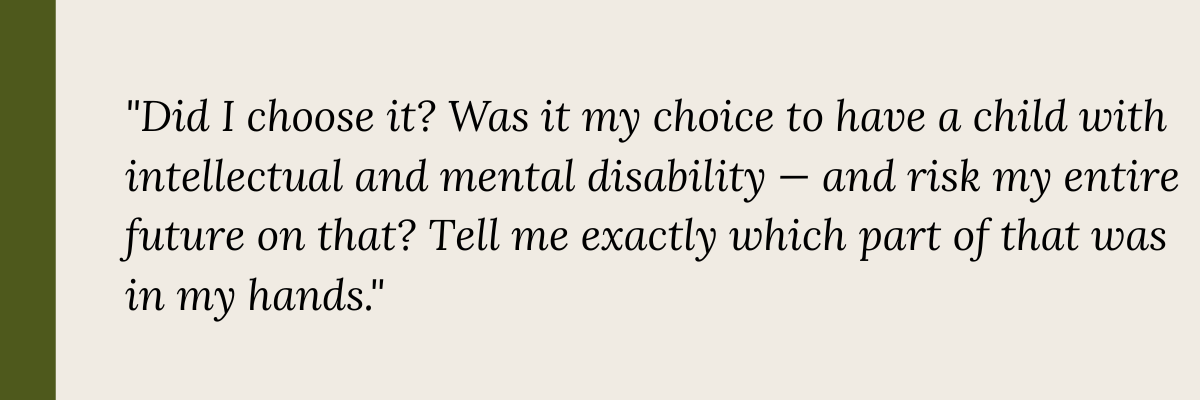
What nobody tells you is what happens when the sacrifice doesn't produce an acceptable return. My children were not diagnosed until they were three and one and a half years old. I did not choose disability. I did not choose children who, as they approach their teens, cannot wipe themselves. Who will never marry. Never hold a job. Never build anything. Who will consume, and then, statistically, die sometime in their thirties.
I have been told — more than once, by more than one person — that I should have aborted them. They were already here when anyone thought to say that.
Where do we land?
Here is what I have learned about whose children the world makes room for:
The pro-natalists want legacy. Lineage. Tax-paying, contributing, dynasty-building children. Mine don't qualify.
The child-free voices use children like mine as the cautionary tale — this is what you're risking, this is what could happen to you. We are the horror story that justifies the argument.
And the mothers in the middle — the ones who would have held me up, compared sleepless nights, complained and laughed and survived alongside me — they moved on. Into school runs and recitals and university open days. Into a future I don't have a version of. I have nothing to put on the table. And the silence where the milestones should be is loud enough that people fill it with conclusions.
The shame
What I feel is shame. I want to be precise about that, because it is not the shame of not loving them enough. I love them. The shame is different — it is the shame of the child holding the broken toy. Of having made a loud, public, committed choice, and having that choice produce something the world has quietly decided not to value. The unspoken contract was never “we support your right to choose. It was “we support your choice as long as the outcome is something we can celebrate”.
Mine isn't. And I am the one left holding it.
So where are you going with all of this, Natalya?
Honestly? Nowhere pretty.
The real answer is there is no path through. The children don't get better. The future doesn't change shape. The milestones don't appear. Anyone who tells you there's a “through” is selling something.
The path isn't through. It's alongside.
That means stop measuring your life against the contract that was never going to honor you anyway. The one that said sacrifice produces reward, choice produces outcome, love produces legacy. That contract was written for a different life. It doesn't apply here. It was never going to apply here.
You are not the broken toy. You are the kid who got one, and has spent every year since trying to convince a room full of people with working toys that you are still worth talking to. That crowd is the wrong crowd. They cannot give you what you're asking for.
The only honest solidarity available is with the people in the same silence. Not in a support group, hand-holding, toxic positivity way. In a you exist, I exist, we are not making this up way.
I am not going to hand you a lesson or ask you to find the beauty in it. I am not going to tell you that love is enough. I'd rather chew glass.
What I will do is stand here, in the dark, with whoever recognizes themselves in this — and make sense of the senseless thing alongside you. Slowly. Badly. Honestly.