
Grief Is Not Depression

For a long time, I thought something was wrong with me.
I wasn't functioning the way I used to. I was tired in a way that sleep couldn't fix. I felt heavy, foggy, like I was moving through the world behind glass. I assumed it was depression — because that's the word we reach for when the sadness doesn't lift and the motivation disappears and the days start bleeding into each other.
But then someone asked me a question that stopped me cold: What are you mourning?
Not what's wrong with you. What are you mourning.
And the answer came fast — faster than I expected. I was mourning a version of my life that didn't exist anymore. A future I'd been counting on. A relationship with someone who had changed. A version of myself that I couldn't get back to.
That wasn't depression. That was grief. And the difference matters more than you might think.
Two different aches
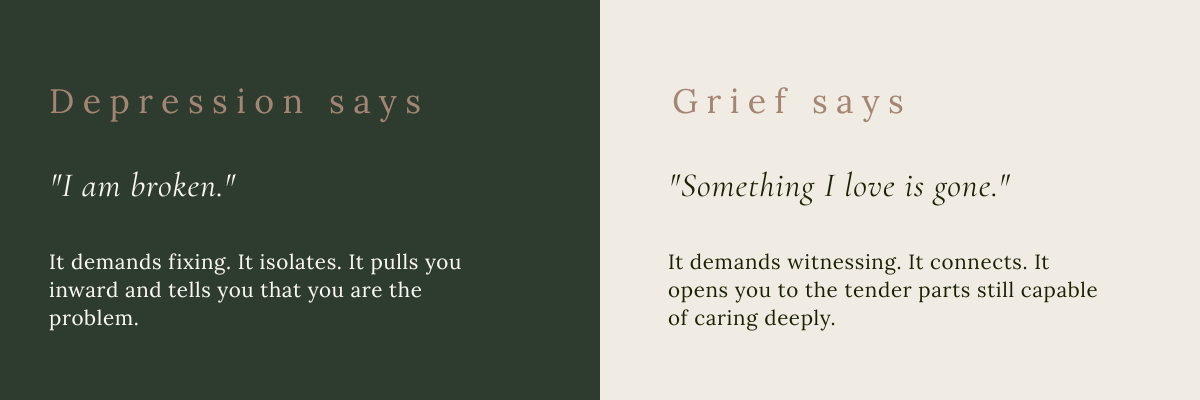
They can feel almost identical — the exhaustion, the numbness, the loss of interest in things you used to enjoy. For caregivers especially, the two blur together, weaving into one heavy silence that's hard to untangle.
But they need very different things from you.
Depression asks to be treated — it often needs professional support, sometimes medication, always compassion. It pulls you inward, isolates you, tells you that you are the problem.
Grief asks to be witnessed. It doesn't need fixing. It needs space. It connects you to something real — to love, to meaning, to the tender parts of yourself that are still capable of caring deeply even when it hurts.
Learning to tell them apart is one of the most important things you can do for yourself.
The grief nobody validates
Here's the part that makes this harder: a lot of what we grieve, other people don't recognize as loss.
The closeness you used to have with a friend who drifted away. The career you set aside. The body you had before kids, before stress, before survival mode took over. The version of your marriage you imagined on your wedding day. The parent you needed but never got.
These losses are real. They deserve to be named, even if no one sends flowers. Even if there's no funeral. Even if the person you're mourning is still alive — or is a version of yourself that no longer exists.
What to do with the ache
You don't have to fix your grief. You don't have to move through it on a timeline. You don't have to journal your way to acceptance by Sunday.
But you can start by naming it. By saying, out loud or on paper: This is what hurts. This is what I lost. This matters to me.
You can light a candle when the weight of it shows up. You can write a letter to the thing you lost — and not send it. You can let yourself cry without narrating why or talking yourself out of it.
And you can stop asking “What's wrong with me?” and start asking “What hurts right now?” — because that question has a much more honest answer.
A gentle place to start
If you're reading this and something in your chest just tightened — pay attention. That's not weakness. That's recognition. That's your body saying, Yes. That. That's the thing I've been carrying.
You don't have to carry it alone. And you don't have to understand it perfectly to begin honoring it. You just have to stop pretending it isn't there.
If this resonated, my workbook was written for exactly this moment. Find it in the shop.